Showing posts with label flexible work. Show all posts

Monday, November 2, 2015

How to Be a Career-Loving Parent: Know Your Work-Life Options


The first installment of this series introduced the idea that "working parent" is a phrase of resignation. With that choice of words, we give up the idea that we can be passionate about both work and family. We resign ourselves to a life in which we can only really be good at one thing. Instead, if we choose to think of ourselves as "career-loving parents," we open up whole new worlds of possibilities for our families, for our careers, and for ourselves. In this installment, we'll look at the many work-life options available to today's career-loving parents.

Before we jump into work options, let's have a quick review of what it takes to be a career-loving parent -- a term I stole from Sheryl Sandberg, who stole it from Caroline O'Connor. While simply changing the words we use makes a big difference in the possibilities we perceive, it also helps to take some concrete steps to integrate our lives as parents with our lives as workers. Here are those steps:
  • Know your work-life style. Do you like to integrate work with the rest of your life, separate work from the rest of your life, or do you like to switch focus back and forth as needed? We covered this in the second article, so jump over to that one if you haven't read it yet.
  • Know your work-life options. In today's world of work, there are more choices than just working outside the home or staying home with the family.
  • Get smart. Regardless of your work-life style and your particular work arrangement, you can make the most of your circumstances with a few simple tricks.

Know your options for when, where, and how you work

Today's world of work is filled with more options than ever before. Thanks to evolving technology, shifting expectations, and research that proves great work can be done in a host of times, places, and styles, anyone with reliable access to a computer, the internet, and a strong work ethic (don't forget that one) can design a career to fit his life -- and a life to fit his career.

Of course, each option has its advantages and disadvantages. You might trade stability of income for flexibility of schedule, or time with family for benefits that take care of them. Whichever option you choose, make it consciously. Consult with both your family and your coworkers. Weigh the tradeoffs mindfully. If you're having trouble figuring out which option is best, though, see if you can arrange some controlled experiments.

If you're having trouble figuring out which option is best, though, see if you can arrange some controlled experiments. Maybe your current full-time, out-of-the-house job is willing to try one work-from-home day weekly. Or maybe you can try working on your home-based business from a co-working space while the kids are at school. Don't fall into the trap of believing that these are your only options -- or that you can only choose one. Instead, think of the table below as a palette from which you can choose one, two, or many colors for your portrait of the ideal career-loving parent.
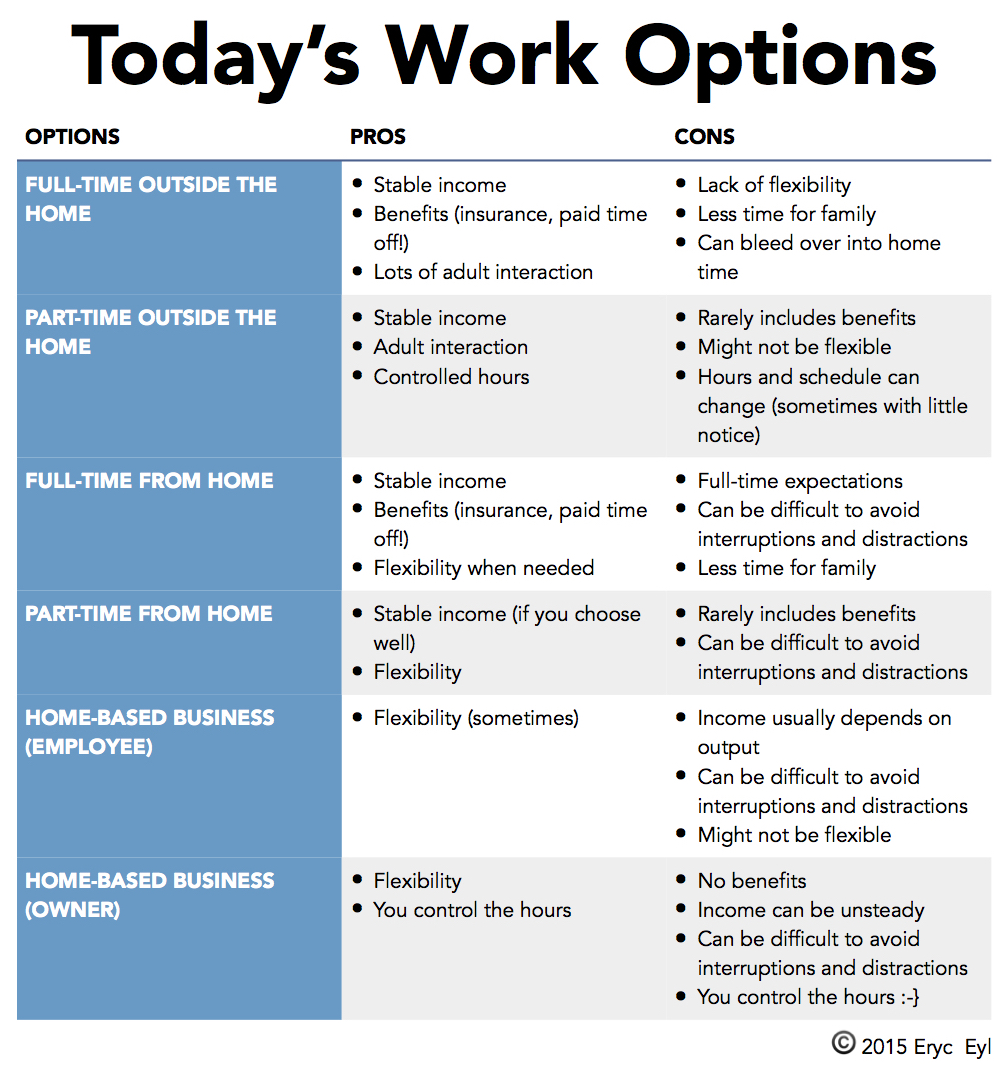
Huffington Post Image

Are there more options than you thought? Are you already thinking of ways you can creatively combine or experiment with these options to design a meaningful, fun, and fulfilling life? Share your story of being -- or aspiring to be -- a career-loving parent in the comments below. Other readers would love to hear from you!

Oh, and come on back next week when we'll dive into the "get smart" step of becoming a career-loving parent, in which we refine what we've learned from the first two steps for the difference that makes a difference.

Dig new ideas about how to integrate your work into a meaningful, fun, and fulfilling life? Trying to keep your head and your heart while keeping your job? You might enjoy my weekly updates.

By: Eryc Eyl


Tuesday, September 1, 2015

Working from home – the pros and cons


Working from home is becoming ever more popular and far easier to do for a range of workers.

Thanks to rapidly growing advances in high speed internet availability, wireless technology, easy teleconferencing software like Go to Webinar, Skype for Business and Microsoft Lync, and the falling cost of office hardware such as personal computers, printers and phones, many people can now make a business case for working from home.

They can show their employer that the organisation will not be financially disadvantaged by having them work from home.

In fact, an employer might make a cost saving, by spending less on things like heating, cooling, lighting, phones, printing, office space and travel-related expenses.

Working from home is an arrangement that suits many working carers. By giving them more autonomy about how they work their core hours, it enables them to effectively juggle their work and caring duties. This in turn may reduce their stress and potentially give them back several ‘lost’ hours each day – time that is usually wasted in getting ready for work, and travelling to and from work, whether on public transport or by personal car.

It also means that they may have the flexibility to do some work in the evening, when their caring duties are less, as their loved one has been settled for the night. That also buys back those precious hours and more evenly spreads their workload over a longer time period each day, but with less intensity.

All of these factors may add up to a considerable cost saving for the employee, as their public transport costs, or petrol costs and car running costs, will be reduced. Other savings can be made by there being less pressure to buy new work clothes, the ability to make low cost and more nutritious meals at home, the ability to have the time to shop smart and take advantage of specials, and having more at-home daylight hours in which to do domestic chores instead of having to pay for extra help.

Working from home may also benefit the health and wellbeing of both the person being cared for, and the worker themselves.

For example there can be more control and timely intervention when medical needs arise – medications can be given correctly and on time; dressings can be changed regularly; visits to the doctor can be more easily arranged; accidents can be avoided as there is better supervision; mental health might be improved as there is less stress generated by not having strangers coming into the house to help with care duties.

The carer, too, may potentially enjoy better health as they may have far less stress, be able to get out into the fresh air and sunshine more frequently, and feel happier and calmer as they have more control over their life.

That is not to say working from home benefits every working carer. Each situation is unique and needs to be assessed on its individual merits and the personality and needs of all involved.

Some working carers thrive on getting away from the house and having a separate life outside their caring role – they feel it is a break away from their caring duties. For them, working from home might be their worst nightmare.

On the ‘con’ side of working from home, working carers may feel that their time is never their own; that they can’t get any separation between their work and home life; that the caring becomes a relentless burden; or that they lose their social support and connection with colleagues. They may also feel that their employer does not see them as committed to their role and that they may be overlooked for special projects and promotions.

Taking genuine sick days may feel awkward, too, as the perception may be that they are already ‘at home’ so they should be able to continue to work. All of these may be very valid reasons for not working from home.

There is no right or wrong answer. A working carer who is considering working from home should consider a three-month trial to see if working from home is practical and delivers the benefits they are expecting.

Even a mix of working say two days at home and three in the office might be a good start for both the employee and the employer, to smooth out any issues in the transition and to still have the flexibility to go back to office-based work if the need arises.

Source: Working Carers Gateway